
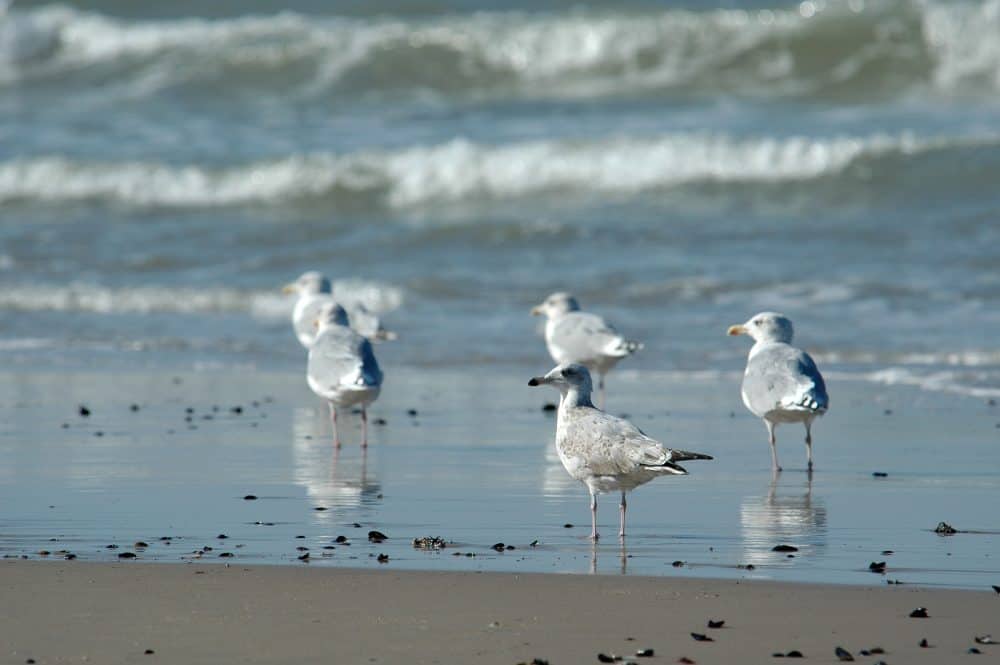
East Coast Beach Birds: How to Identify 12 Common Gulls and Seabirds
Birds almost always accompany a walk along an East Coast beach. Some glide effortlessly above the waves, others gather along the shoreline searching for food, while a few boldly patrol parking lots and picnic areas in hopes of finding an easy meal.
Among the most familiar are gulls. Nearly everyone recognizes them, yet few people realize there are several different species, each with its own size, markings, habits, and preferred habitat. At first glance they can all look alike, but once you know a few key field marks, identifying them becomes much easier.
Whether you’re strolling a quiet beach in Maine, exploring the marshes of New Jersey, birding the barrier islands of the Carolinas, or watching the surf along Florida’s Atlantic coast, you’re likely to encounter many of the birds in this guide.
In this article, you’ll learn how to identify the most common East Coast beach birds, discover which species are year-round residents and which arrive only during winter, and meet a few offshore specialists that reward patient observers with binoculars or a spotting scope. Along the way, I’ll also share some memorable birding experiences and a few fun facts that make these remarkable birds even more interesting.
Did You Know? There Really Isn’t a Bird Called a “Seagull”
Here’s a fun fact that surprises many people: there is no bird officially named a seagull.
Open any modern field guide, and you’ll find gulls, terns, kittiwakes, and jaegers—but you won’t find a species simply called a seagull. The name has become so common in everyday conversation that even birders occasionally use it out of habit, but “seagull” is really just a catch-all term for several different kinds of seabirds.
For the rest of this guide, I’ll put on my birder hat and stick with the correct name: gulls.
One reason gull identification can be frustrating is that most species take several years to develop their adult plumage. Juvenile birds often begin life wearing mottled shades of brown before gradually replacing those feathers with the crisp gray, black, and white plumage of adulthood. As they mature, their appearance changes so much that a first-year gull can look like an entirely different species.
When you’re trying to identify an unfamiliar gull, don’t rely on plumage alone. Watch its size, bill shape, leg color, behavior, and the company it keeps. If an odd-looking bird spends all afternoon with a flock of American Herring Gulls, there’s a good chance it’s simply a young American Herring Gull working its way toward adulthood.
The more time you spend observing gulls, the easier those subtle differences become to recognize.
How to Identify East Coast Beach Birds
Many beginning birders are intimidated by gulls, but you don’t need to memorize dozens of field marks to identify most species. Start by looking for a few simple characteristics.
Size is often the first clue. A Great Black-backed Gull towers over a Ring-billed Gull, making the two easy to separate when they’re standing together.
Next, look at the leg color. Pink, yellow, or dark legs can quickly narrow your options.
The bird’s back, or mantle, color is another important feature. Some gulls have pale gray backs, while others are much darker, almost black.
Finally, watch how the bird behaves. Does it soar high over the surf? Patrol the parking lot? Hover over the waves? Chase other birds to steal their food? Behavior is often just as useful as plumage when identifying a gull.
With those basics in mind, let’s meet the species you’re most likely to encounter.
Great Black-backed Gull (Larus marinus)
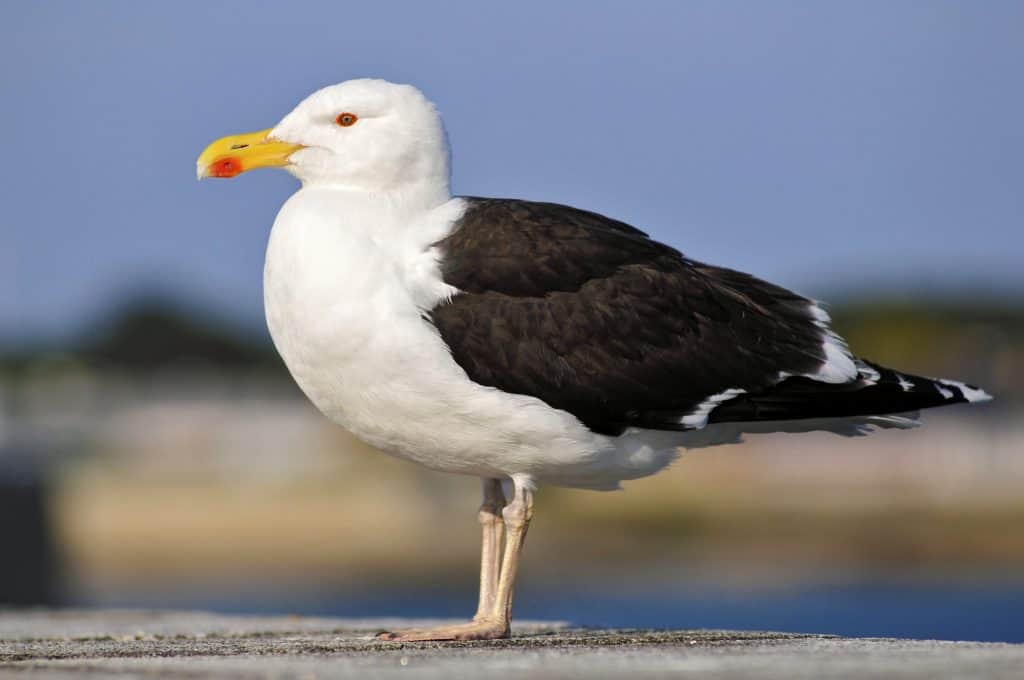
Size: 30 inches
Wingspan: 65 inches
If there’s a heavyweight champion among East Coast gulls, this is it. The Great Black-backed Gull is the largest gull in North America and one of the easiest to identify. Adults have a jet-black back and wings, a bright white head and body, pink legs, and a thick yellow bill with a red spot near the tip.
You’ll encounter them along rocky coastlines, sandy beaches, harbors, fishing docks, and estuaries throughout the Northeast. Although they occur farther south during winter, they become increasingly common as you travel north.
Their impressive size isn’t just for show. Great Black-backed Gulls are formidable predators that will hunt fish, crabs, seabirds, and even mammals when given the opportunity. They’re also expert scavengers, taking advantage of anything from dead fish to discarded food left behind by beachgoers.
Facts, Tips & Fun Stuff
One of the most remarkable wildlife moments I’ve ever witnessed involved a Great Black-backed Gull on a frozen bay.
A flock of Greater Scaup had gathered in one of the few patches of open water. Without warning, the gull dropped into the flock, pinned a female duck beneath the surface, and held her underwater until she drowned. Before the gull could enjoy its hard-earned meal, however, a Bald Eagle swooped down, grabbed the duck, and flew away—proving that even the biggest gull isn’t always at the top of the food chain.
Watching nature unfold like that is unforgettable, even when it’s a little hard to watch.
Lesser Black-backed Gull (Larus fuscus)
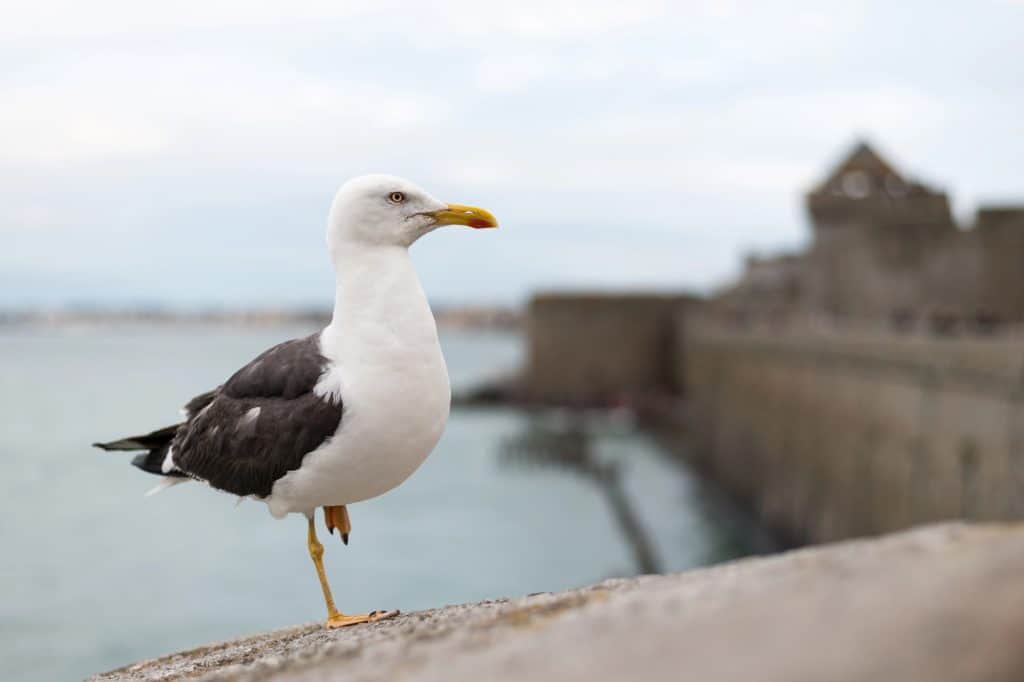
Size: 20–25 inches
Wingspan: 53–59 inches
The Lesser Black-backed Gull is one of those birds that often causes birders to take a second look. At first glance it resembles an American Herring Gull, but a closer inspection reveals several important differences.
Its dark slate-gray back contrasts sharply with its white body, and unlike the pink-legged Herring Gull, the Lesser Black-backed Gull sports bright yellow legs. It also has a slimmer build, longer pointed wings, and a more elegant profile.
A helpful field mark is the length of the wings. When the bird is standing, the folded wingtips extend noticeably beyond the end of the tail, giving it a sleek, streamlined appearance.
Originally a European species, the Lesser Black-backed Gull has become an increasingly regular winter visitor along the Atlantic Coast. Today it’s seen every winter from New England south through Florida, and each year more birders add it to their beach checklists.
Facts, Tips & Fun Stuff
Five subspecies of Lesser Black-backed Gull are recognized worldwide. The birds most commonly seen in North America belong to the subspecies Larus fuscus graellsii, which has the palest gray mantle of the group. In contrast, the Baltic subspecies (Larus fuscus fuscus) has an almost black back, making it look remarkably similar to a Great Black-backed Gull from a distance.
The Most Common East Coast Beach Birds
These are the gulls that most people are familiar with, whether they realize it or not. If you’ve ever spent a day at the beach, wandered around a marina, or stopped for lunch in a waterfront parking lot, you’ve probably encountered at least one of these species.
While they share many similarities, each has its own personality, preferred habitat, and identifying features. Learning to recognize them is one of the easiest ways to improve your birding skills.
American Herring Gull (Larus smithsonianus)
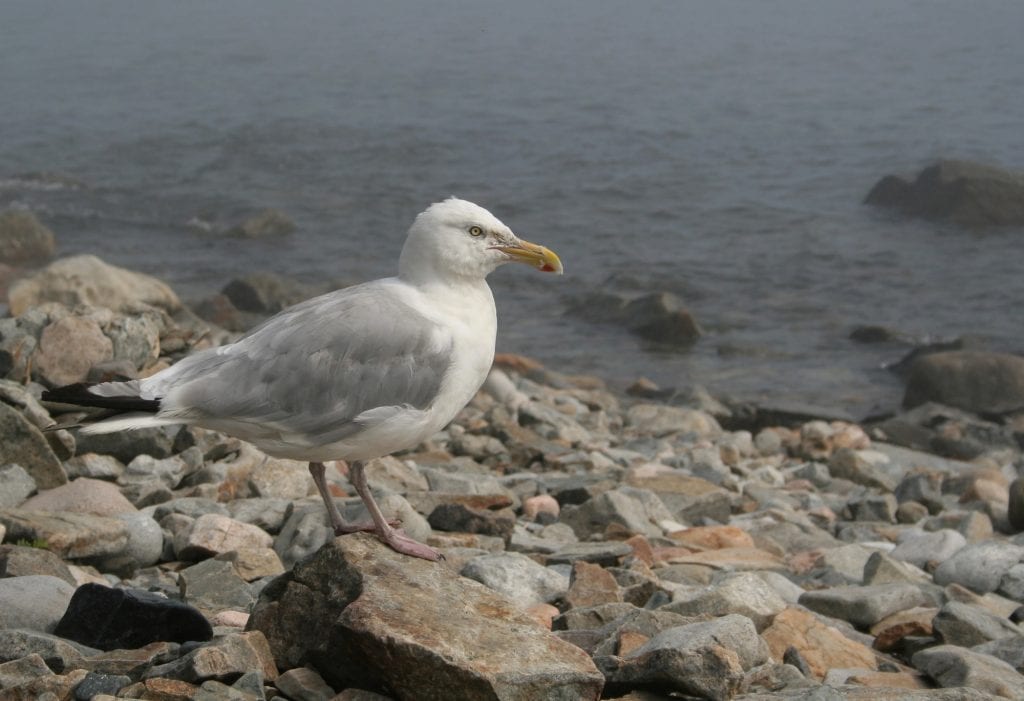
Size: 22–26 inches
Wingspan: About 58 inches
When most people picture a gull, they’re thinking of the American Herring Gull. It’s the classic beach bird—large, noisy, and seemingly everywhere along the Atlantic coast.
Adults are easy to recognize with their white head and body, pale gray back, black wingtips dotted with white “mirrors,” and sturdy pink legs. Their hefty yellow bill, marked with a distinctive red spot near the tip, is another key field mark.
American Herring Gulls are true opportunists. You’ll find them soaring over beaches, following fishing boats, scavenging at marinas, patrolling parking lots, and even waiting outside restaurants for an easy meal. If you’ve ever had a gull eyeing your sandwich or swooping in to snatch a French fry, chances are it was an American Herring Gull.
They’re intelligent, adaptable birds that have learned to thrive anywhere people provide food. While they can seem bold—even a little mischievous—their adaptability is one reason they’ve become one of the most successful coastal birds in North America.
Facts, Tips & Fun Stuff
Despite their reputation as beach scavengers, American Herring Gulls are skilled hunters and capable predators. They’ll eat fish, crabs, shellfish, insects, small mammals, and even other birds when the opportunity arises.
For many years this species was simply known as the Herring Gull. Recent taxonomic research separated what was once considered a single worldwide species into several distinct species. The bird found throughout most of North America is now officially known as the American Herring Gull.
Listen for: the familiar loud, laughing “kee-ow” call that’s become part of the soundtrack of nearly every East Coast beach.
Ring-billed Gull (Larus delawarensis)
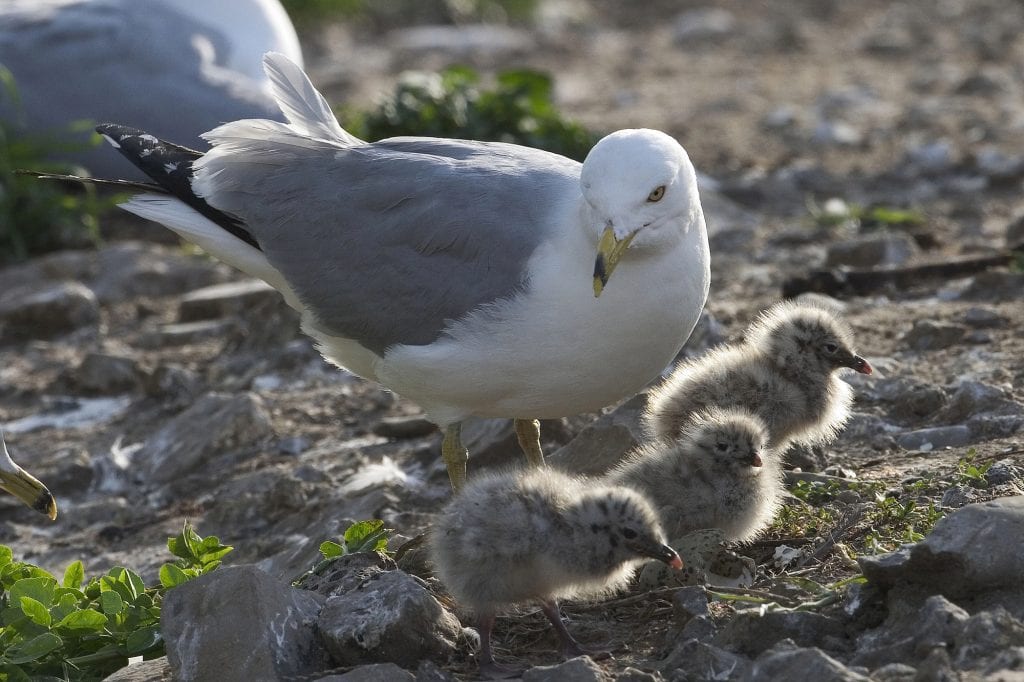
Size: 17–21 inches
Wingspan: 41–46 inches
Smaller and more graceful than the American Herring Gull, the Ring-billed Gull is one of the most common birds you’ll encounter throughout the Northeast.
The easiest way to identify an adult is by the thin black ring that circles its bright yellow bill. Add yellow legs, a clean white body, and a pale gray back, and you’ve got one of the easiest gulls to recognize.
Although they’re common along beaches and bays, Ring-billed Gulls are just as comfortable inland. They’re regular visitors to reservoirs, city parks, shopping centers, school athletic fields, and supermarket parking lots. If there’s an open space with people and food nearby, there’s a good chance a Ring-billed Gull will show up.
These birds are highly social and often gather in large flocks. During migration and winter, hundreds—or even thousands—may roost together before dispersing to feed.
Unlike some of their larger relatives, Ring-billed Gulls are agile flyers. They frequently hover into the wind, perform graceful aerial maneuvers, and can quickly change direction while searching for food.
Facts, Tips & Fun Stuff
Ever wonder where those parking lot gulls come from?
A Massachusetts research project tagged Ring-billed Gulls at a local supermarket and tracked their movements. Many of those birds later turned up hundreds of miles away along the Atlantic Coast, showing just how widely these adaptable gulls travel.
If you see a flock of medium-sized gulls circling a grocery store parking lot, odds are you’re looking at Ring-billed Gulls.
Listen for: a higher-pitched, nasal “kree-ar” that’s less harsh than the call of the American Herring Gull.
Laughing Gull (Leucophaeus atricilla)
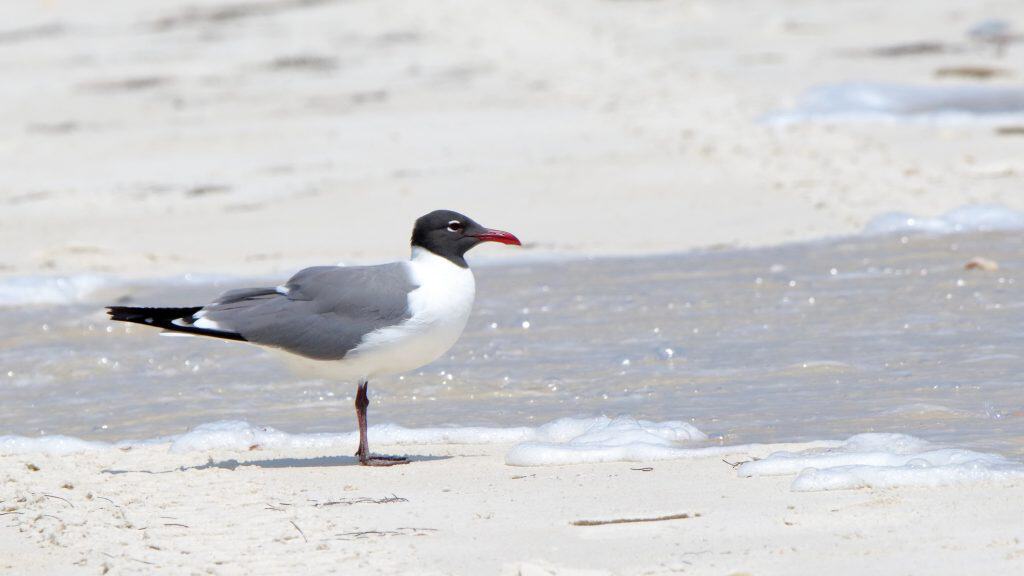
Size: 16½ inches
Wingspan: About 40 inches
Few birds announce summer at the beach quite like the Laughing Gull.
During the breeding season, adults sport a striking black head, dark gray back, white underparts, and deep reddish-black bill and legs. Their bold plumage makes them one of the easiest East Coast gulls to identify.
As winter approaches, however, they undergo a dramatic wardrobe change. The black hood disappears, leaving a mostly white head with dusky smudges behind the eye and on the nape—a look that often confuses beginning birders.
Laughing Gulls are especially common from the Mid-Atlantic states south to Florida, where they nest in large colonies on barrier islands, salt marshes, and coastal estuaries. During summer they’re a familiar sight over beaches, circling fishing piers, and following boats in search of an easy meal.
They’re energetic, noisy, and wonderfully entertaining to watch. Few gulls are as agile in the air, and they’re never shy about helping themselves to unattended snacks.
Facts, Tips & Fun Stuff
Their name isn’t an exaggeration. Once you’ve heard their loud, cackling call, you’ll understand exactly how the Laughing Gull got its name. It sounds remarkably like a group of people laughing across the beach.
If you’re eating lunch near the water, don’t leave your food unattended. Laughing Gulls are clever opportunists, and they’ll happily claim it for themselves.
Listen for: their unmistakable laughing “ha-ha-ha-ha-ha” call.
Bonaparte’s Gull (Chroicocephalus philadelphia)
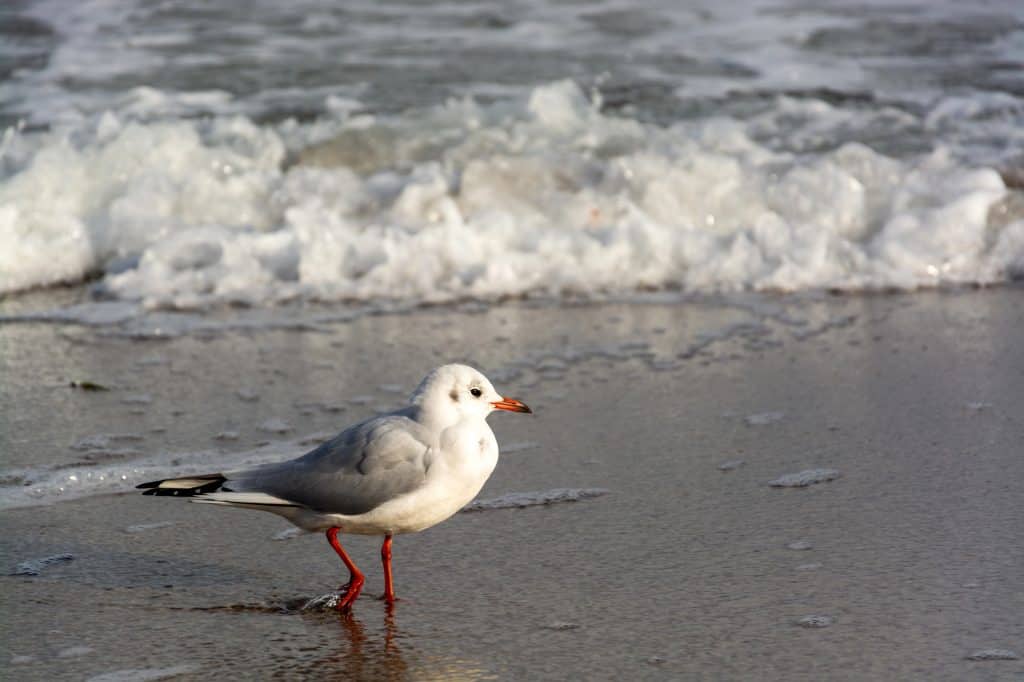
Size: 13½ inches
Wingspan: About 33 inches
Bonaparte’s Gull is one of the smallest gulls regularly seen along the East Coast, and one of the most elegant.
Unlike the larger, heavier gulls that patrol beaches and parking lots, Bonaparte’s Gulls seem to float effortlessly above the waves. Their graceful flight, quick wingbeats, and delicate appearance often remind birders more of terns than gulls.
During winter, adults have a mostly white head marked by a small black spot just behind the eye, a slim black bill, and reddish or dark pink legs. In breeding season they develop a full black hood, though most East Coast birders encounter them during winter migration.
They often feed by dipping to the water’s surface rather than scavenging on beaches, making them fun to watch as they skim low over bays, estuaries, and sheltered coastal waters.
Facts, Tips & Fun Stuff
One of the easiest ways to identify a Bonaparte’s Gull in flight is the bright white wedge along the leading edge of the wing. Once you learn to spot it, this field mark stands out surprisingly well.
Among birders, you’ll often hear them affectionately called “Bonies.”
Black-headed Gull (Chroicocephalus ridibundus)
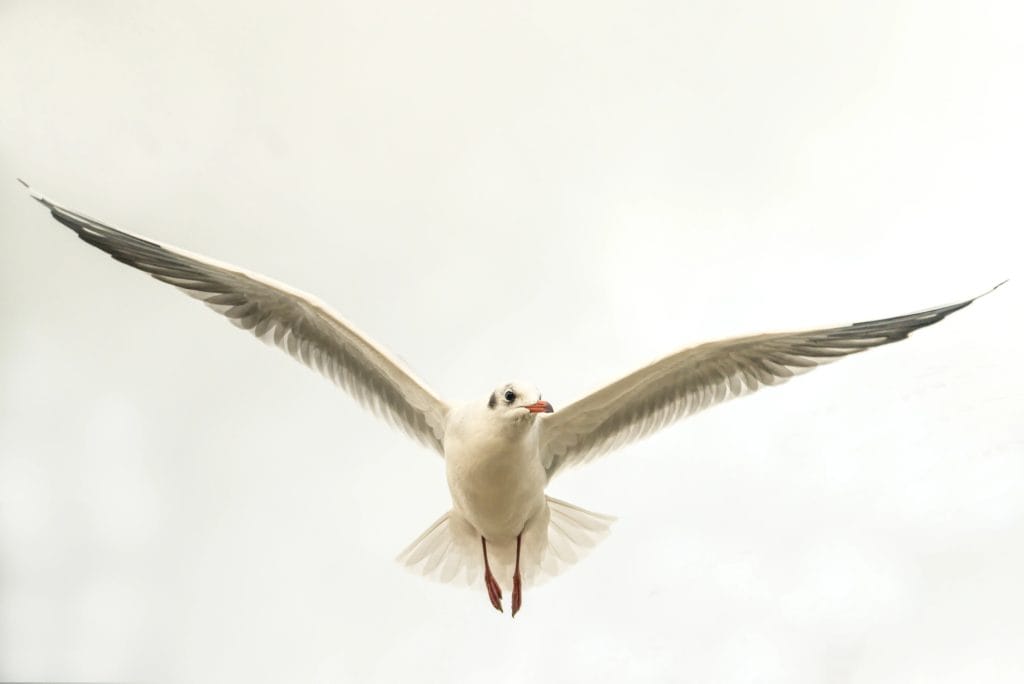
Listen for: a soft, high-pitched call that’s much quieter than the larger gulls.
Size: About 16 inches
Wingspan: About 40 inches
Despite its name, the Black-headed Gull usually isn’t black-headed when East Coast birders see it.
Like the Laughing Gull, its chocolate-brown breeding hood disappears during winter, leaving behind only a dark spot near the eye. Because most individuals seen in North America are winter visitors, many birders never see the famous “black” head at all.
Black-headed Gulls are uncommon visitors from Europe but appear regularly enough that experienced birders always keep an eye out for one mixed among flocks of Bonaparte’s or Ring-billed Gulls.
Compared with Bonaparte’s Gull, they’re slightly larger and stockier, with a heavier reddish bill, darker red legs, and darker undersides to the outer wing feathers.
Facts, Tips & Fun Stuff
Unlike Bonaparte’s Gulls, which spend much of their time feeding over water, Black-headed Gulls are just as comfortable foraging in open fields, parks, and agricultural land. That behavior often provides an important clue when you’re trying to separate the two species.
Listen for: a sharp, nasal series of calls that carry surprisingly well over the wind.
Little Gull (Hydrocoloeus minutus)
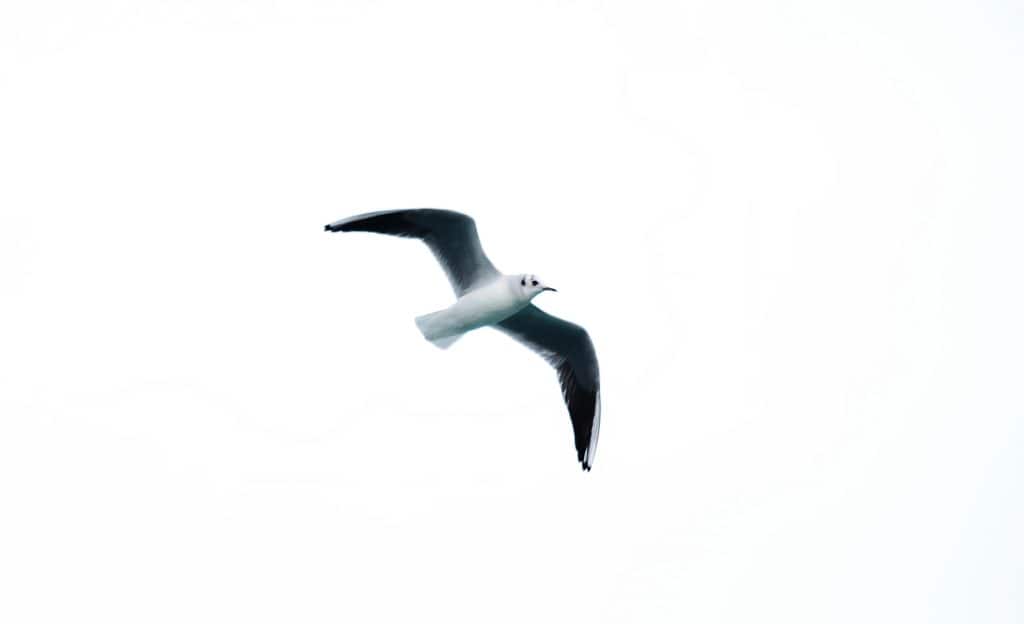
Size: About 11 inches
Wingspan: About 24 inches
The Little Gull lives up to its name. It’s the smallest gull in the world and one of the trickiest East Coast species to identify.
Most sightings occur well offshore or over large bays, where distance alone can make identification challenging. Even experienced birders often need binoculars or a spotting scope to pick one out among flocks of Bonaparte’s Gulls.
At first glance they look remarkably similar, but one field mark stands above all the others. When the bird banks in flight, look carefully at the underside of the wings. Adult Little Gulls have noticeably dark underwings, creating a striking contrast that’s unlike any other small gull regularly seen along the Atlantic Coast.
Their buoyant, tern-like flight and tiny size also help separate them from the surrounding gulls.
Facts, Tips & Fun Stuff
The easiest way to find a Little Gull is often to search through flocks of Bonaparte’s Gulls. Little Gulls frequently associate with them during migration and winter, so patient scanning can sometimes reward you with one of the East Coast’s most sought-after small gulls.
Finding your first Little Gull takes patience—but once you finally spot that distinctive dark underwing, you’ll wonder how you ever missed it.
Listen for: their calls are seldom heard from shore because most birds remain well offshore or are seen only briefly during migration.
Winter Visitors and Offshore Specialists
Now we’re getting to some of my favorite birds. These are the species that make winter birding along the Atlantic Coast especially exciting. Spotting one of them can turn an ordinary beach walk into a memorable day.
While the gulls we’ve already covered are birds you’re likely to see on almost any trip to the beach, the next three species are much less predictable. Two arrive from the Arctic during winter, while the third spends most of its life far offshore. Finding any of them is always a thrill, especially if you’re scanning the shoreline with binoculars or a spotting scope.
Black-legged Kittiwake (Rissa tridactyla)
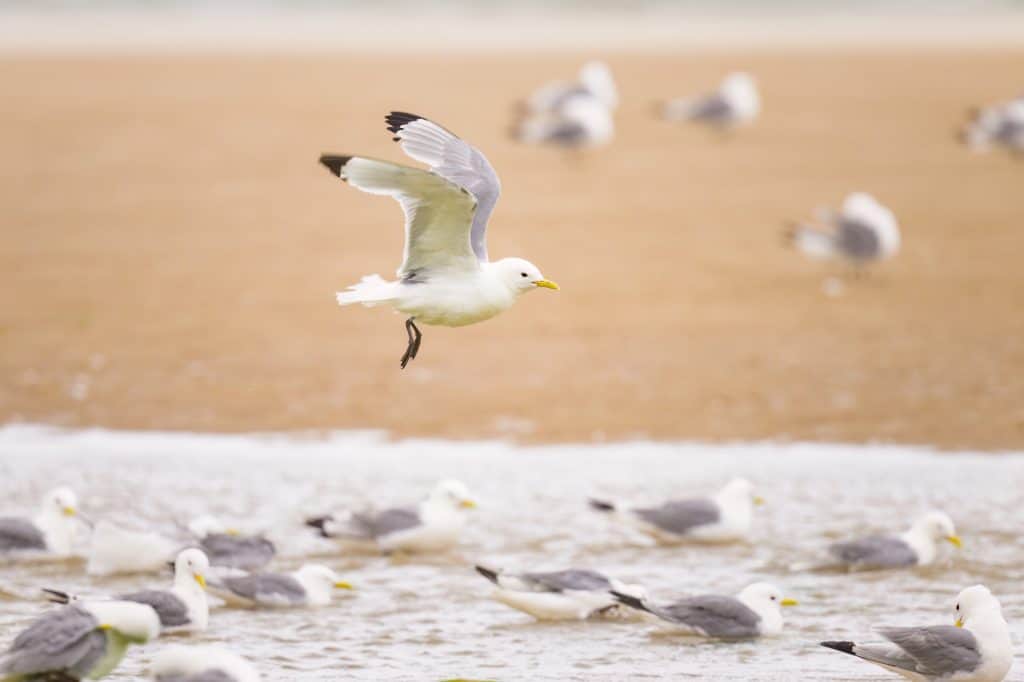
Size: 17 inches
Wingspan: About 36 inches
At first glance, a Black-legged Kittiwake looks like a small gull. Look a little closer, though, and you’ll notice that everything about it seems more delicate. Its body is slimmer, its wings are longer and narrower, and its graceful flight often resembles that of a tern.
Unlike most gulls, Black-legged Kittiwakes spend very little time on beaches. They are true pelagic birds, living almost entirely over the open ocean and only coming to land to nest on steep sea cliffs. Along the East Coast, they’re most often seen during winter, especially after strong coastal storms that push them closer to shore.
Adults are easy to recognize by their pearl-gray back, bright white body, solid black wingtips without the usual white spots seen on larger gulls, short yellow bill, and, of course, their black legs—the feature that gives them their name.
Because they usually remain well offshore, a spotting scope greatly improves your chances of finding one. Look for small groups flying low over the waves or resting beyond the breakers.
Facts, Tips & Fun Stuff
For years, the Black-legged Kittiwake topped my “most wanted” bird list. Every winter I’d scan flocks of distant gulls hoping one would appear.
Then, one unforgettable day, it finally happened.
Thanks to my friend Andy, who spotted it first, I was able to add this beautiful seabird to my life list. Moments like that are one of the reasons birding is so addictive—you never know when persistence will finally pay off.
Their call sounds remarkably like their name: kitti-waake…kitti-waake, though winter birds are often surprisingly quiet.
Iceland Gull (Larus glaucoides)
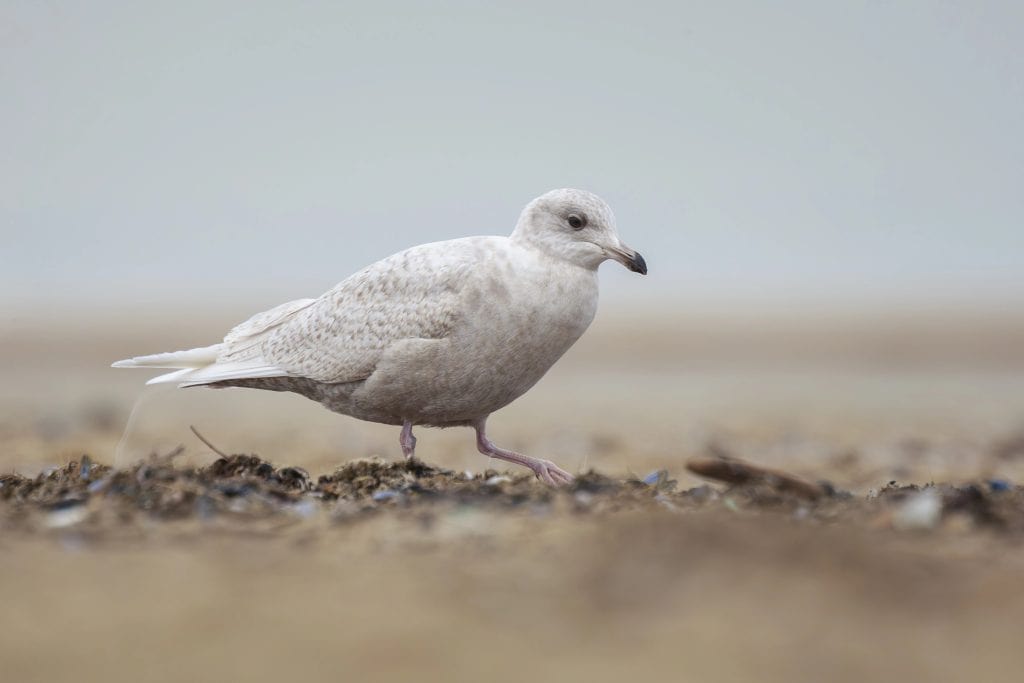
Size: About 22 inches
Wingspan: About 54 inches
If you’ve spent enough winters birding the Northeast, you’ve probably heard someone excitedly shout, “There’s an Iceland Gull!”
These elegant Arctic visitors are among the most sought-after winter gulls on the East Coast. Adults have a soft, pale-gray back, bright white head and body, pink legs, and a noticeably smaller, gentler-looking bill than the larger American Herring Gull.
One of the best field marks is what isn’t there. Adult Iceland Gulls have little to no black on the wingtips, giving them an unusually clean, almost ghostly appearance when they’re flying.
Young birds are another story entirely.
First-year Iceland Gulls are creamy white to light tan with delicate brown streaking and a dark bill. Their pale overall appearance often makes them stand out immediately among darker juvenile American Herring Gulls.
Most East Coast sightings occur between late fall and early spring, especially around harbors, beaches, fishing piers, and coastal landfills where large flocks of gulls gather.
Facts, Tips & Fun Stuff
Iceland Gull taxonomy has kept birders on their toes for years. What were once considered separate species—including Thayer’s Gull—are now treated as forms of the Iceland Gull complex.
For East Coast birders, the vast majority of birds encountered are the Kumlien’s form, which typically shows pale gray wingtips rather than the pure white wingtips of classic Iceland Gulls.
Fortunately, unless you’re diving deep into gull identification, you don’t need to worry too much about the finer details. For most birders—and for eBird and ABA listing purposes—it’s simply an Iceland Gull.
Finding one mixed into a flock of Herring Gulls always feels like discovering a rare gem.
Glaucous Gull (Larus hyperboreus)
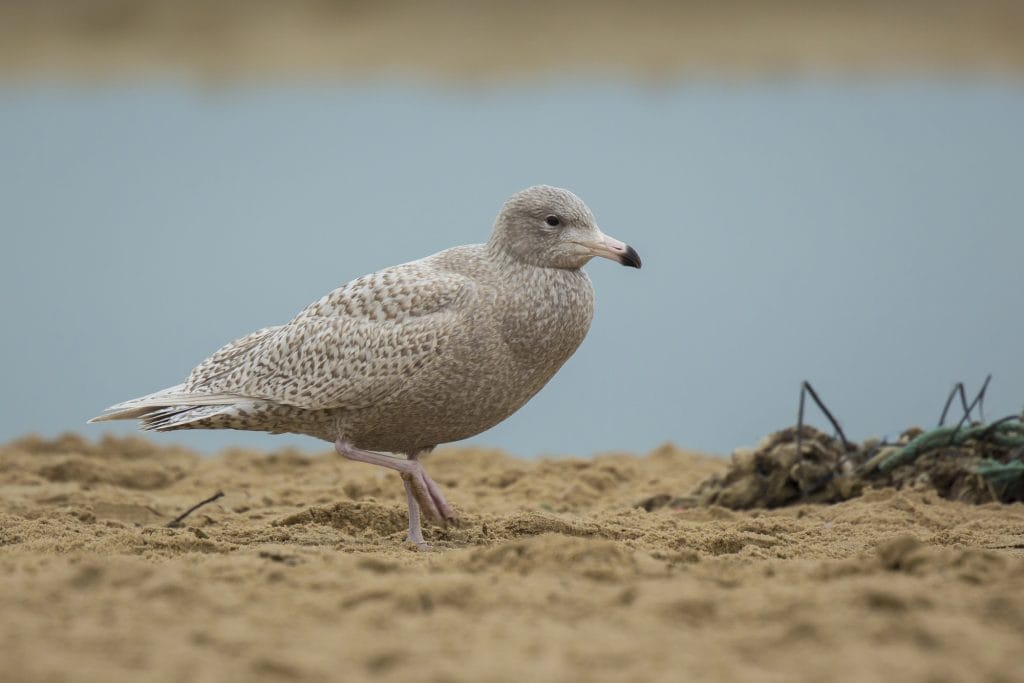
Size: About 27 inches
Wingspan: About 60 inches
If the Iceland Gull looks elegant, the Glaucous Gull looks powerful.
This massive Arctic species is one of the largest gulls in the world and immediately impresses with its broad body, heavy bill, and commanding presence. Although slightly shorter than the Great Black-backed Gull, it is often heavier, giving it an incredibly bulky appearance.
Adults are surprisingly clean-looking birds. Their back is a soft pearl gray, while the head, tail, and wingtips are entirely white—a feature that separates them from nearly every other large gull you’ll encounter on the East Coast.
Young Glaucous Gulls look dramatically different.
First-year birds are huge, pale tan to creamy-white gulls covered in soft brown mottling. Their oversized pink-and-black bill and bulky proportions often make them look awkward, almost as though they haven’t quite grown into their bodies.
Winter is the best time to search for Glaucous Gulls, particularly along the coasts of New England, New York, and the Canadian Maritimes. They often mingle with large flocks of Herring Gulls around fishing harbors, beaches, and landfills.
Facts, Tips & Fun Stuff
Life in the Arctic isn’t easy, and Glaucous Gulls have adapted by becoming formidable predators and scavengers.
They’ll eat fish, seabird eggs, chicks, lemmings, carrion, marine mammals, and just about anything else they can find. Their size allows them to dominate many other seabirds when food is scarce.
Watching a Glaucous Gull standing beside an American Herring Gull is one of the easiest ways to appreciate just how enormous these birds really are.
Winter Gull Watching Tips
Winter is, without question, the best season for gull enthusiasts.
As northern birds move south, beaches and harbors become gathering places for an incredible variety of species. A single flock might contain American Herring Gulls, Great Black-backed Gulls, Ring-billed Gulls, Iceland Gulls, Glaucous Gulls, and perhaps even a rarity hiding among them.
If you’re hoping to improve your gull identification skills:
- Visit fishing harbors, inlets, and beaches after winter storms.
- Bring binoculars or, even better, a spotting scope.
- Scan every gull instead of assuming they’re all Herring Gulls.
- Pay attention to leg color, bill size, wingtip patterns, and overall shape.
- Most importantly, take your time. The rare bird is often hiding in plain sight.
The more gulls you study, the more subtle differences you’ll begin to notice.
The Pirates of the Sea – Jaegers
If gulls are the beachcombers of the Atlantic Coast, Jaegers are the pirates.
These powerful seabirds spend most of their lives far offshore, rarely coming to land except to breed in the Arctic. Instead of catching all of their own food, they often steal it from gulls, terns, and other seabirds by chasing them through the air until the exhausted bird drops its meal.
Witnessing this behavior is one of the highlights of any seawatch.
Jaegers are fast, agile, and incredibly athletic, making them some of the most exciting birds you’ll ever see over the ocean.
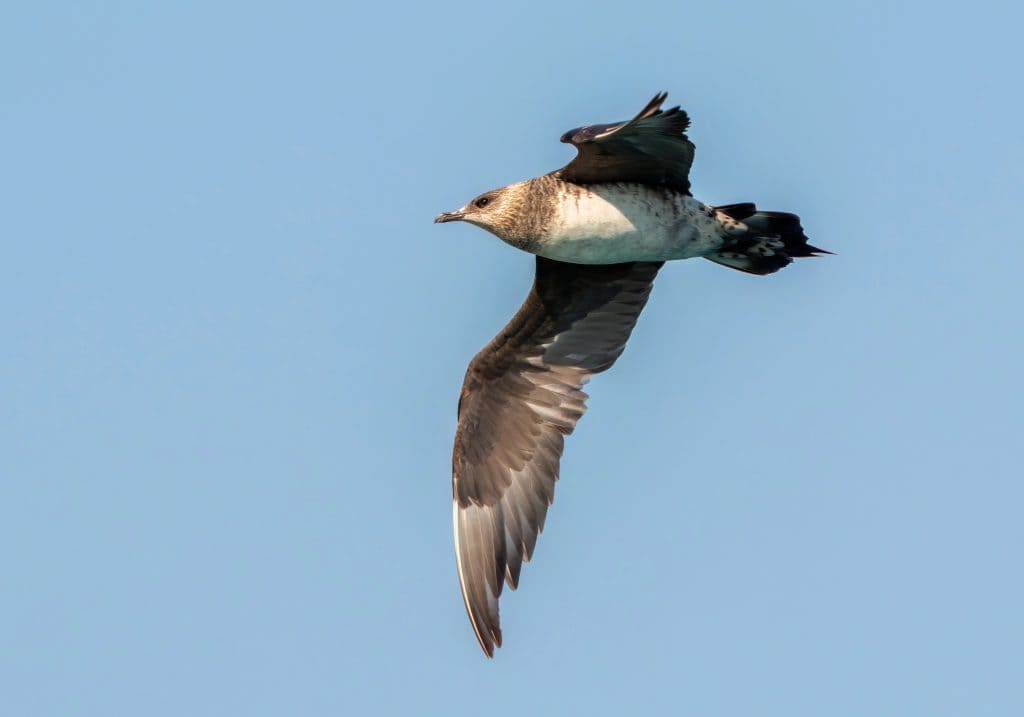
Parasitic Jaeger (Stercorarius parasiticus)
Size: 15–21 inches
Wingspan: 42–47 inches
The Parasitic Jaeger is the species East Coast birders are most likely to spot from shore.
Its broad chest, pointed wings, and powerful flight immediately set it apart from the gulls it relentlessly pursues. Adults occur in two color forms, or morphs.
The light morph has a creamy-white neck and chest, dark cap, and rich brown upperparts.
The dark morph is chocolate brown overall with only subtle contrasts in the wings.
One of the best identification features is the pointed central tail feathers, which create a long, triangular silhouette unlike the squared-off tails of gulls.
Unlike gulls that spend their time soaring or scavenging, Parasitic Jaegers fly with purpose. If you notice one bird aggressively chasing gulls, terns, or shearwaters until they drop a fish, you’ve probably found a Parasitic Jaeger.
Facts, Tips & Fun Stuff
The word parasitic refers to the bird’s feeding strategy, known as kleptoparasitism—stealing food from other animals rather than catching it themselves.
Watching one harass a gull until it drops its catch is impressive. The jaeger often catches the falling fish before it even reaches the water.
Size: 17–24 inches
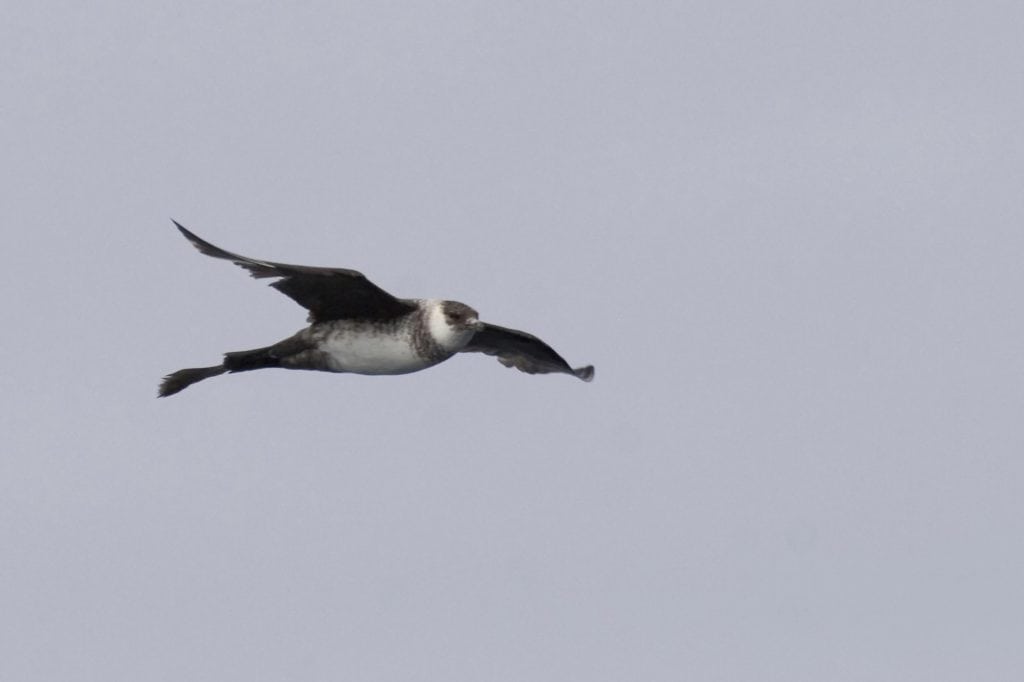
Pomarine Jaeger (Stercorarius pomarinus)
Wingspan: 45–52 inches
The Pomarine Jaeger is the heavyweight of the trio.
Larger and bulkier than the Parasitic Jaeger, it has broader wings, a thicker body, and a noticeably heavier bill. Adults also occur in both light and dark morphs.
Light birds show a white belly and neck separated by a dark brown chest band, while dark birds appear mostly chocolate brown.
A useful field mark is the large white flashes in the underwings, which are much more prominent than those of the other jaeger species.
Although Pomarine Jaegers also steal food from other seabirds, they’re less agile than Parasitic Jaegers and often rely on their size to intimidate their victims.
Facts, Tips & Fun Stuff
Pomarine Jaegers are usually seen well offshore, but strong nor’easters and hurricanes occasionally push them close enough to shore for lucky birders to enjoy spectacular views.
If you’re planning a whale watch or pelagic birding trip, this is often the jaeger you’re most likely to encounter.
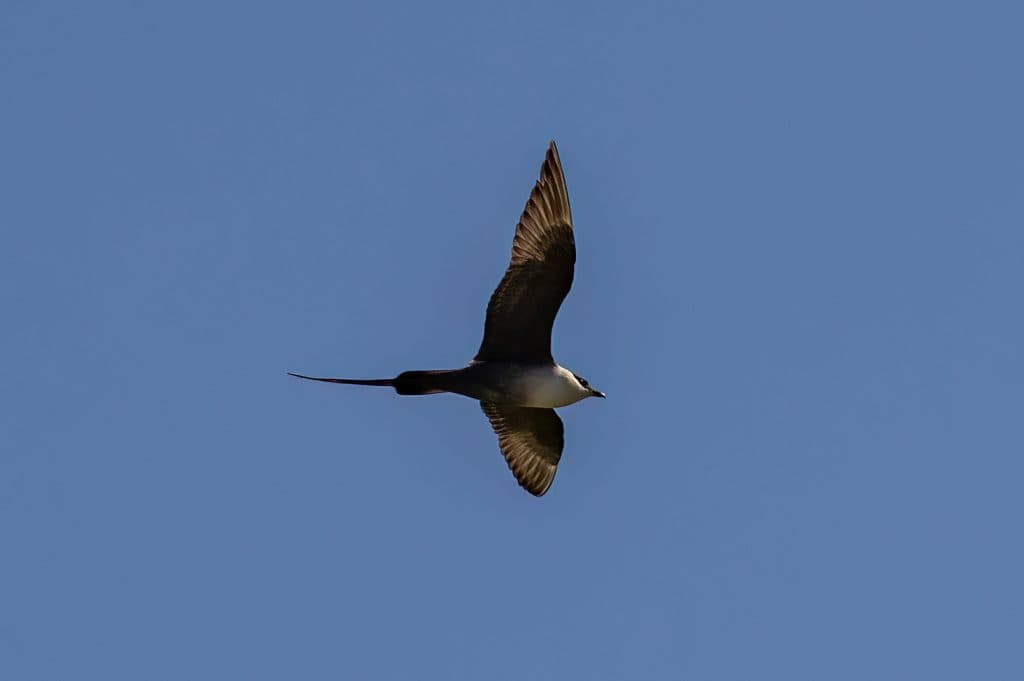
Long-tailed Jaeger (Stercorarius longicaudus)
Size: 15–24 inches
Wingspan: 41–44 inches
Many birders consider the Long-tailed Jaeger the most elegant member of the family.
Its slim body, narrow wings, and graceful flight give it an appearance that’s almost tern-like. During breeding season, the dramatically elongated tail feathers create one of the most distinctive silhouettes among seabirds.
Adults have a dark cap, pale breast, and soft golden wash across the sides of the neck. Their smaller bill and lighter build help distinguish them from the heavier Parasitic and Pomarine Jaegers.
Unfortunately, they’re also the least likely species to be seen from shore.
Facts, Tips & Fun Stuff
Long-tailed Jaegers spend much of their lives far out over the open ocean.
Unless storms bring them closer to land, your best opportunity to see one is on a pelagic birding excursion or a whale-watching trip.
For many East Coast birders, spotting a Long-tailed Jaeger is a memorable life bird.
How to Tell the Jaegers Apart
At first glance, all three species can look remarkably similar. Fortunately, a few field marks make identification much easier.
Parasitic Jaeger
- Medium-sized
- Narrow, pointed central tail feathers
- Moderate amount of white in the underwing
- Most likely to be seen from shore
- Extremely agile and aggressive
Pomarine Jaeger
- Largest and heaviest species
- Broad wings
- Large white flashes in the underwing
- Thick bill
- Twisted, spoon-shaped tail feathers on breeding adults
Long-tailed Jaeger
- Smallest and most slender
- Long, elegant tail streamers
- Least amount of white in the wing
- Most graceful flight
- Usually found farthest offshore
A good rule of thumb is this:
The farther offshore you are, the better your chances of seeing Long-tailed Jaegers. Closer to shore, Parasitic Jaegers are usually the species you’ll encounter.
One of the greatest joys of birding is discovering just how much wildlife surrounds us, even during a simple walk along the beach.
Final Thoughts on East Coast Beach Birds
What many people casually call “seagulls” are actually a fascinating group of birds with unique behaviors, incredible migration stories, and surprising intelligence. From the familiar American Herring Gull stealing fries on the boardwalk to an Arctic Glaucous Gull spending the winter along the Atlantic Coast, every species has its own story to tell.
And don’t forget to look beyond the breakers. With a pair of binoculars—or better yet, a spotting scope—you might spot a Black-legged Kittiwake gliding over the waves or a Jaeger chasing another seabird across the horizon.
Whether you’re a dedicated birder or simply someone who enjoys spending time by the ocean, learning to identify East Coast beach birds adds a whole new dimension to every coastal visit.
The next time you’re standing on the shoreline, take a closer look. You may discover there’s much more than “just another seagull.”
Happy birding! “Just get out there and ‘sea’ the gulls!”
Frequently Asked Questions About East Coast Beach Birds
What is the most common beach bird on the East Coast?
The American Herring Gull is one of the most common gulls found along the Atlantic Coast, especially around beaches, fishing piers, marinas, and coastal towns. Ring-billed Gulls and Laughing Gulls are also widespread, depending on the season and location.
Are there really no birds called seagulls?
Correct. “Seagull” is a popular nickname, but no bird species officially carries that name. The birds most people call seagulls belong to the gull family, which includes many different species.
When is the best time to see rare gulls?
Winter is the best season. Arctic species such as the Iceland Gull and Glaucous Gull migrate south, joining large mixed flocks along beaches, harbors, and coastal inlets.
Do I need a spotting scope to identify gulls?
Not always. Common species can usually be identified with binoculars, but a spotting scope is extremely helpful for distant birds and offshore species like Black-legged Kittiwakes and Jaegers.
Which East Coast beach birds steal food from other birds?
Jaegers are famous for stealing food in flight, a behavior known as kleptoparasitism. They chase gulls, terns, and other seabirds until the victim drops its catch.


